
Private clubs depend on people to deliver exceptional member experiences. From the first interaction at the front desk to dining, golf operations, maintenance, events, and management, employees shape how members experience the club every day. That makes employee engagement more than an HR issue; it is an operational and service-quality issue.
One useful way to measure that engagement is Employee Net Promoter Score, or eNPS.
eNPS asks employees a simple question:
“On a scale of 0 to 10, how likely are you to recommend this club as a great place to work?”
Responses are grouped into three categories. Employees who score 9 or 10 are considered Promoters. Those who score 7 or 8 are Passives, while employees who score from 0 to 6 are Detractors.
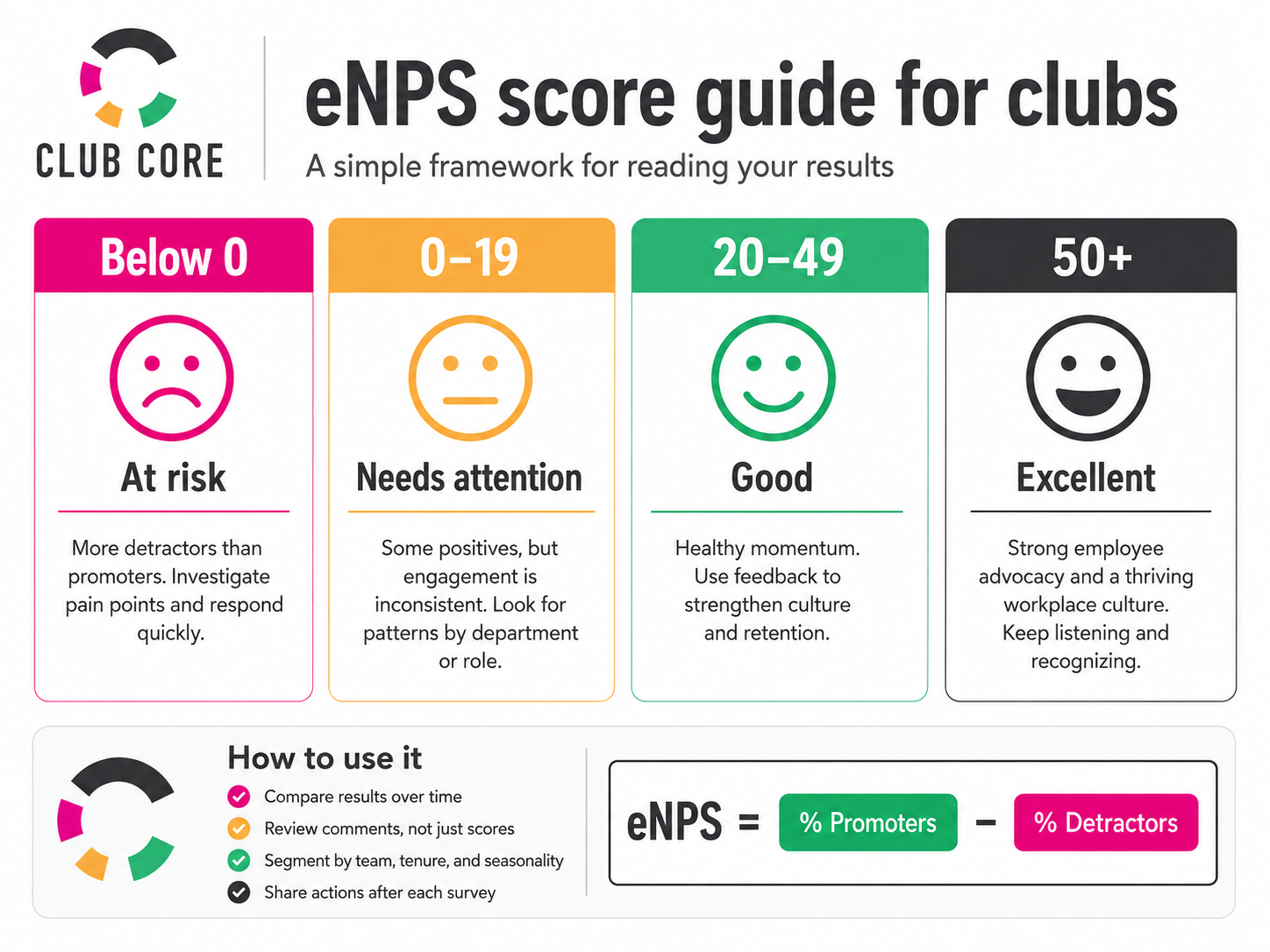
The eNPS score is calculated by subtracting the percentage of Detractors from the percentage of Promoters. Scores can range from -100 to +100.
But the score itself is only the starting point.
What Clubs Should Measure
The most useful eNPS programs combine the headline score with questions that help explain why employees feel the way they do.
Clubs should look for patterns in several areas:
Engagement: Do employees feel proud to work at the club and motivated to perform at their best?
Leadership: Do employees trust their managers and understand the club’s direction?
Communication: Are important updates, expectations, and operational information easy to access?
Culture: Do employees feel respected, supported, and connected to the organization?
Recognition and growth: Do employees feel their contributions are noticed, and do they see opportunities to learn and advance?
Retention risk: Are employees planning to stay, or are there warning signs that key team members may leave?
A simple follow-up question such as, “What is one thing we could do to make this a better place to work?” can often provide more actionable insight than the score alone.
What Does a Good eNPS Look Like?
There is no universal eNPS benchmark that applies equally to every organization, so clubs should be cautious about focusing too heavily on a single industry number. The most valuable benchmark is often the club’s own performance over time.
As a practical guide, a positive score means there are more Promoters than Detractors. Scores in the 20 to 49 range can indicate healthy employee sentiment, while 50 or higher generally reflects a highly engaged workforce. Scores near zero suggest there is significant room for improvement, and a negative score should prompt closer attention to the employee experience.
The direction of the score matters just as much as the number itself.
A club that moves from 5 to 25 may be making meaningful progress even if it has not yet reached an aspirational benchmark.
Measure, Listen, Act
eNPS works best when clubs measure consistently, protect employee anonymity, review results by department or role, and communicate what happens next.
Employees are far more likely to participate honestly when they see that feedback leads to action.
For clubs, the ultimate goal is not simply a higher eNPS score. It is a stronger workplace culture. When employees feel informed, valued, supported, and connected to the club’s mission, they are better positioned to deliver the consistent, exceptional experience members expect.